

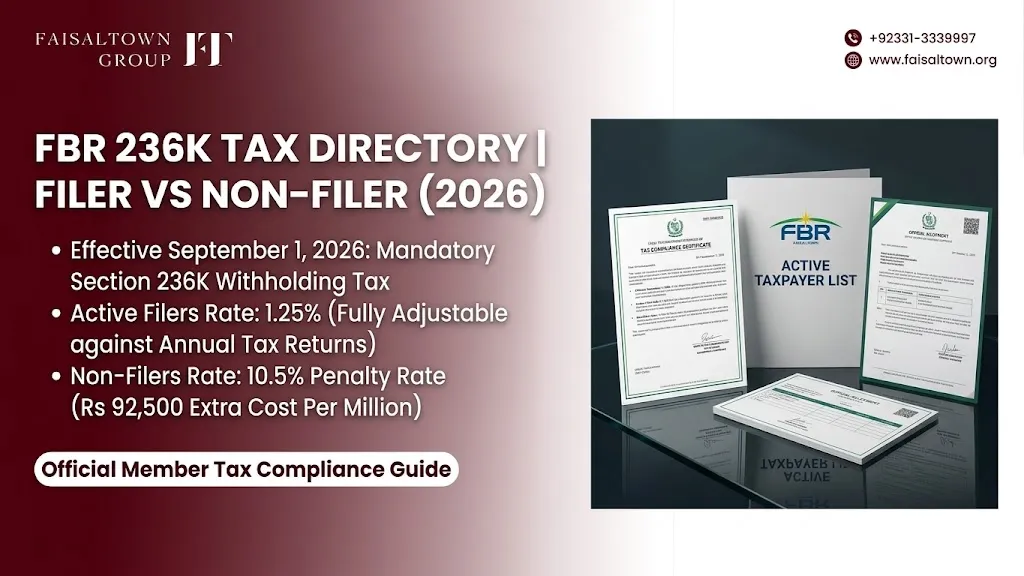
The implementation of Faisal Town Phase 2 Installment Tax under Section 236K was originally scheduled for August 1, 2026, but has been postponed to September 1, 2026. This means installment payments processed from September 1, 2026, onwards will be subject to the tax, giving members additional time to prepare and verify their filer status before the new rate applies.
If you’re currently paying installments toward a plot in Faisal Town Phase 2, this change directly affects how much you’re paying each month, and the difference between filer and non-filer status is significant enough that it’s worth understanding clearly before your next payment.
This guide breaks down what Section 236K actually is, the exact rates now being applied, and what this means practically for your ongoing installments.
What Is Section 236K
Section 236K of Pakistan’s Income Tax Ordinance is an advance income tax collected at the time of purchasing immovable property. It’s not a new tax created specifically for Faisal Town Phase 2, it’s a standard federal tax that applies broadly to property transactions across Pakistan, and several established housing authorities already collect it directly through member installments, similar to what Faisal Town Phase 2 has now implemented.
Because it’s an advance tax, filers can adjust the amount deducted against their annual income tax liability when they file their return. Non-filers do not have this option, since they aren’t filing a return to claim it against.
Who Actually Collects This Tax
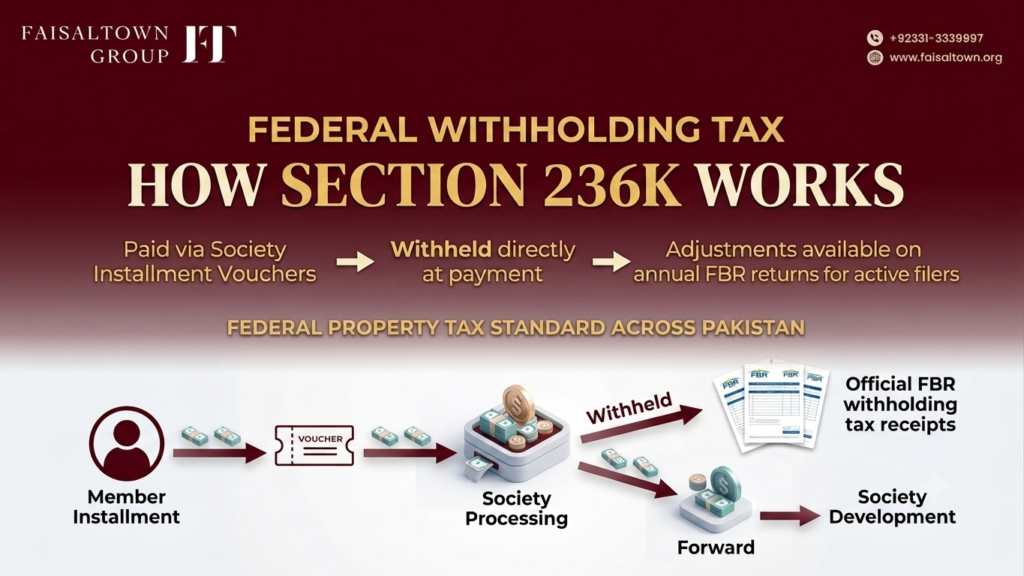
The tax isn’t collected by FBR directly from your bank account. Instead, it’s withheld by the entity handling the transaction, in this case, Faisal Town Phase 2 itself, at the time your installment payment is processed. This is how withholding tax generally works in Pakistan for property transactions, whether the collecting entity is a housing society, a registrar’s office, or a bank handling a transfer.
This means the tax will appear as a deduction on your payment voucher or account statement rather than as a separate bill you need to arrange yourself.
Faisal Town Phase 2’s New Tax Rates
According to the circular issued to members, Section 236K will now be collected alongside installment payments made from September 1, 2026 onward. The rates specified are:
| Filer Status | Tax Rate |
| Filer | 1.25% |
| Non-Filer | 10.5% |
The filer rate of 1.25% reflects the current federal rate under Section 236K following recent revisions to the applicable Finance Act, which reduced the standard advance tax rate on immovable property purchases for active filers.

What This Actually Costs: A Simple Example
Percentages are easier to understand with real numbers attached. Take an installment payment of Rs. 1,000,000:
- Filer tax at 1.25%: Rs. 12,500
- Non-filer tax at 10.5%: Rs. 105,000
That’s a difference of Rs. 92,500 on a single installment payment, purely based on whether you’re registered as an active filer on FBR’s records. For members paying larger installments, or those with several months of installments outstanding, this gap becomes substantial very quickly.
What Happens on Larger or Smaller Installments
The tax scales directly with your installment amount, so it’s worth seeing how this plays out across a few different payment sizes:
| Installment Amount | Filer Tax (1.25%) | Non-Filer Tax (10.5%) | Difference |
| Rs. 100,000 | Rs. 1,250 | Rs. 10,500 | Rs. 9,250 |
| Rs. 500,000 | Rs. 6,250 | Rs. 52,500 | Rs. 46,250 |
| Rs. 1,000,000 | Rs. 12,500 | Rs. 105,000 | Rs. 92,500 |
| Rs. 2,000,000 | Rs. 25,000 | Rs. 210,000 | Rs. 185,000 |
As the table shows, the gap between filer and non-filer status grows in direct proportion to your payment size, which matters most for members with large outstanding balances or those paying bigger plot sizes.

Why This Matters More If You Have Outstanding Installments
If you’ve fallen behind on installments and are planning to clear several months at once, this tax now applies to those payments as well. Members with accumulated outstanding installments should check their updated payment voucher or account statement carefully before clearing dues, since the tax will now be calculated on the total amount being paid, not just future installments going forward.
This makes confirming your current FBR filer status before making a large catch-up payment particularly important. A gap of nearly 9.25 percentage points between filer and non-filer rates can mean the difference of tens or even hundreds of thousands of rupees on a substantial outstanding balance.

How to Check and Improve Your Filer Status
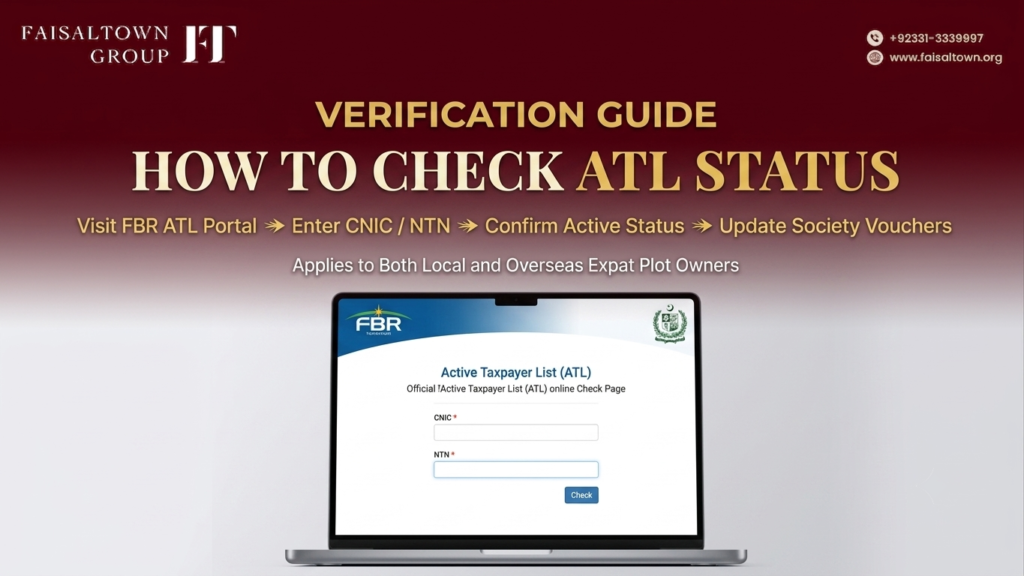
Your filer status is determined by whether you appear on FBR’s Active Taxpayer List (ATL), which reflects whether you’ve filed your income tax return. If you’re currently a non-filer, becoming an active filer before your next installment payment can significantly reduce the 236K tax applied to that payment.
You can check your current status directly through FBR’s online ATL verification tools, and filing a return, if you haven’t already for the relevant tax year, is the standard way to move from non-filer to filer status.
What Overseas Members Should Know About Filer Status
Overseas Pakistanis are sometimes uncertain about where they stand on FBR’s filer classification, particularly if they haven’t filed a Pakistani tax return while living abroad. Filer status is tied to your own tax filing record with FBR, regardless of where you currently live, so an overseas member’s status depends entirely on whether they’ve filed a return, not on their country of residence.
If you’re unsure of your status, checking the ATL directly, or speaking with a tax consultant familiar with overseas filer requirements, is worth doing before your next installment is processed.
What This Means Going Forward for Faisal Town Phase 2 Members
This isn’t a one-time charge, it applies to installment payments going forward from September 1, 2026, which means it’s worth factoring into your ongoing budget for the remainder of your payment plan, not just your next single payment. Members planning to pay in a lump sum, or those close to completing their installment plan, should also confirm how this tax applies to their specific remaining balance directly with the developer or their authorized dealer.
Common Mistakes Members Make With This Tax
A few mistakes are worth avoiding now that this tax is in effect. Some members assume their filer status is automatically updated the moment they file a return, without checking whether FBR’s ATL has actually reflected the update before their next payment is processed. Others plan a lump-sum catch-up payment without recalculating the tax on the full outstanding amount, only to be surprised by a larger deduction than expected.
It’s also worth not confusing this tax with any registration fee, transfer charge, or other cost already built into your payment plan, since 236K is a separate, federally mandated deduction rather than a developer fee.

Have Questions About How This Tax Applies to Your Installments? Contact Us Today
If you’re unsure how Section 236K affects your specific payment plan, whether you’re a filer or non-filer, or how it applies to an outstanding balance, our team can walk you through the exact figures for your account. Call or WhatsApp us at +92 331 3339997, or email info@faisaltown.org.