
This Pakistan Property Investment Guide for UK Pakistanis is written for anyone in Birmingham, Bradford, London, or elsewhere in the UK thinking about buying land or a home back in Pakistan — you’re part of a large and growing group. British Pakistanis send remittances home every year, and more of that money is now going into property rather than sitting untouched. This guide isn’t tied to one project or one city. It’s a broader look at where UK-based buyers are actually putting their money, what protects that money, and where the real risks sit.
Whether you’re buying your first plot or adding to a portfolio you already hold in Pakistan, the practical realities covered in this Pakistan Property Investment Guide for UK Pakistanis matter more than any single glossy brochure.
Why the UK’s Pakistani Diaspora Keeps Buying Land Back Home
Part of the reason is straightforward math. Property prices in Pakistan, particularly in Islamabad and Rawalpindi, have historically shown stronger long-term appreciation than leaving cash in a low-interest UK savings account.
Part of it isn’t financial at all. Plenty of families want somewhere to return to, a plot set aside for their children, or simply a tangible link to where they came from. And the currency math helps too: the rupee has weakened considerably against the pound over the past decade, so a pound-earning buyer often finds their money stretches further in Pakistan than it would buying anything comparable in the UK.
What Makes Overseas Property Buying Different From Local Buying
Buying as someone based in the UK isn’t the same exercise as buying as a resident, and pretending otherwise is where a lot of mistakes start.
- You can’t physically inspect a site on a whim
- You’re relying on family or agents for on-the-ground verification
- Currency conversion and international transfers add a layer local buyers don’t deal with
- Property law for overseas buyers changes periodically, and it’s easy to work from outdated information
- Telling a legitimate developer apart from an unauthorised one is harder from a distance
Everything in this guide is built around addressing those five gaps directly, rather than repeating generic advice written for someone who can just drive to the site.
Comparing Pakistan’s Top Property Markets
Most conversations about overseas Pakistani property investment eventually narrow down to four or five cities.
Islamabad remains the benchmark for planned, CDA-regulated development. Sectors like E-11 and D-12, along with the growing Islamabad Expressway corridor, keep drawing interest from local and overseas buyers thanks to modern infrastructure and green space that’s actually maintained.
Rawalpindi has grown quickly on the back of affordability and proximity to Islamabad. Areas near the Thalian Interchange and the M-2 Motorway corridor, including several RDA-regulated housing societies, have seen strong demand from the diaspora specifically.
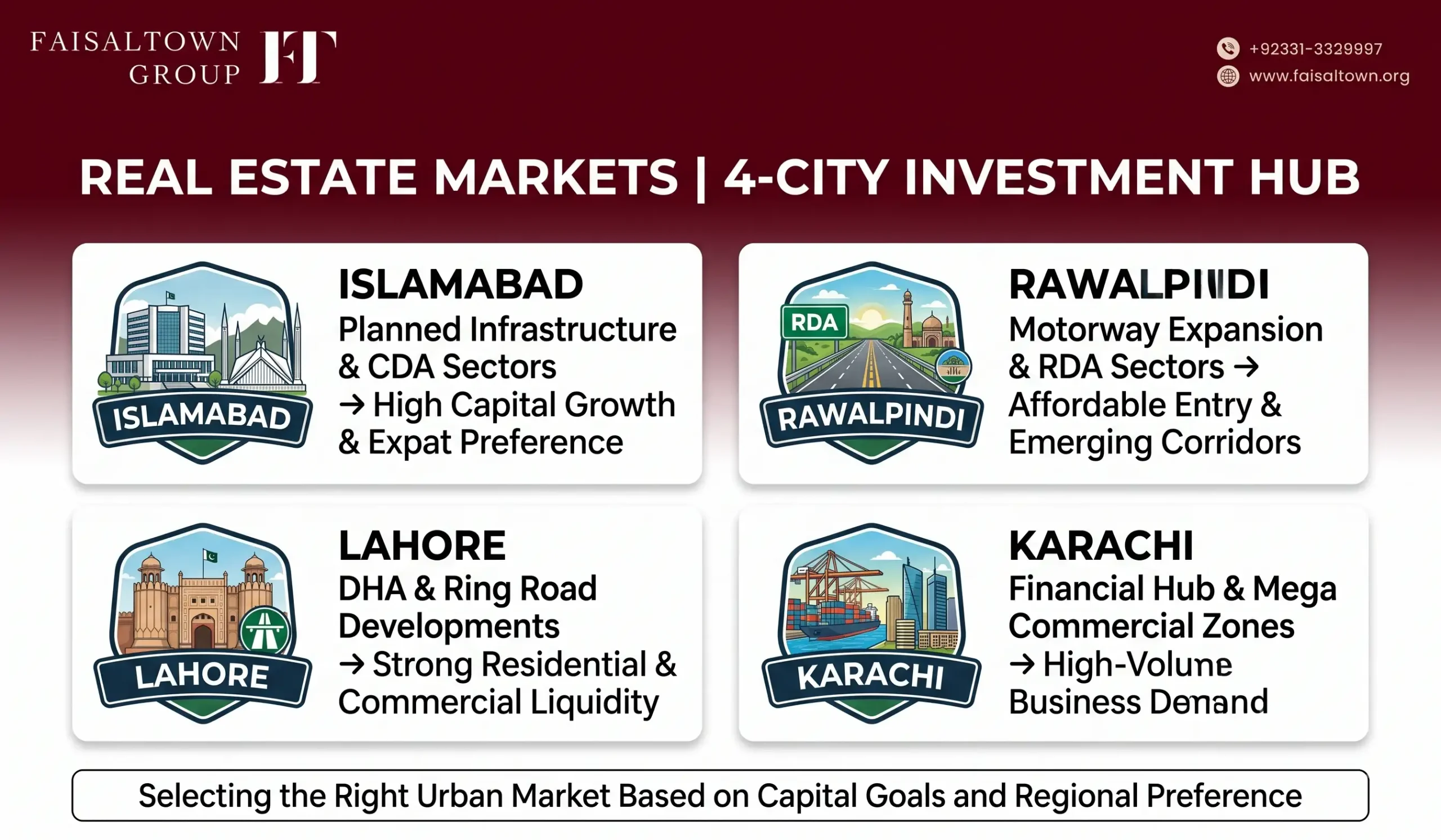
Lahore continues to appeal to buyers with Punjab roots. DHA Lahore, Bahria Town, and newer developments along the Ring Road span a wide range of price points for both residential and commercial plots.
Karachi is Pakistan’s largest property market by transaction volume. DHA Karachi and Bahria Town Karachi remain popular, though the city’s dense and sometimes contested land records mean legal due diligence deserves extra attention here.
| City | Best For | Investment Highlights | Suitable Investors |
| Islamabad | Residential, long-term hold | Planned infrastructure, premium societies, strong appreciation history | Families, long-term investors |
| Rawalpindi | Affordable entry | Proximity to Islamabad, expanding road network | First-time buyers |
| Lahore | Residential and commercial | Large population, active business environment | Business owners, rental investors |
| Karachi | Commercial investment | Pakistan’s financial hub, high commercial demand | Experienced investors |
| Peshawar | Emerging opportunities | Growing infrastructure, expanding residential supply | Long-term, patient investors |
Two Islamabad Projects Worth a Closer Look
No guide like this would be complete without naming names, so here are two that come up constantly in these conversations: Faisal Town Phase 2 and its sister project, Faisal Hills.
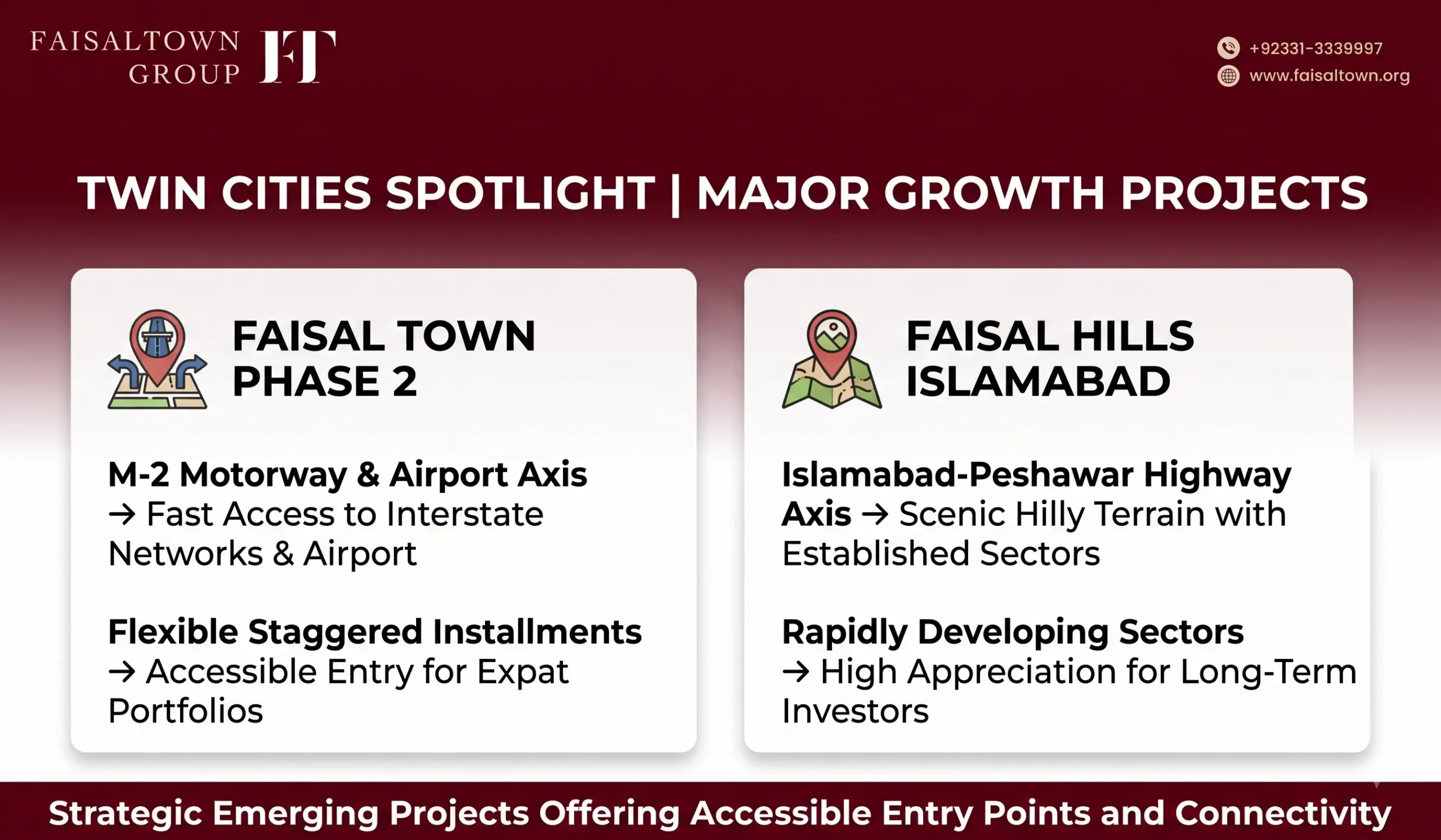
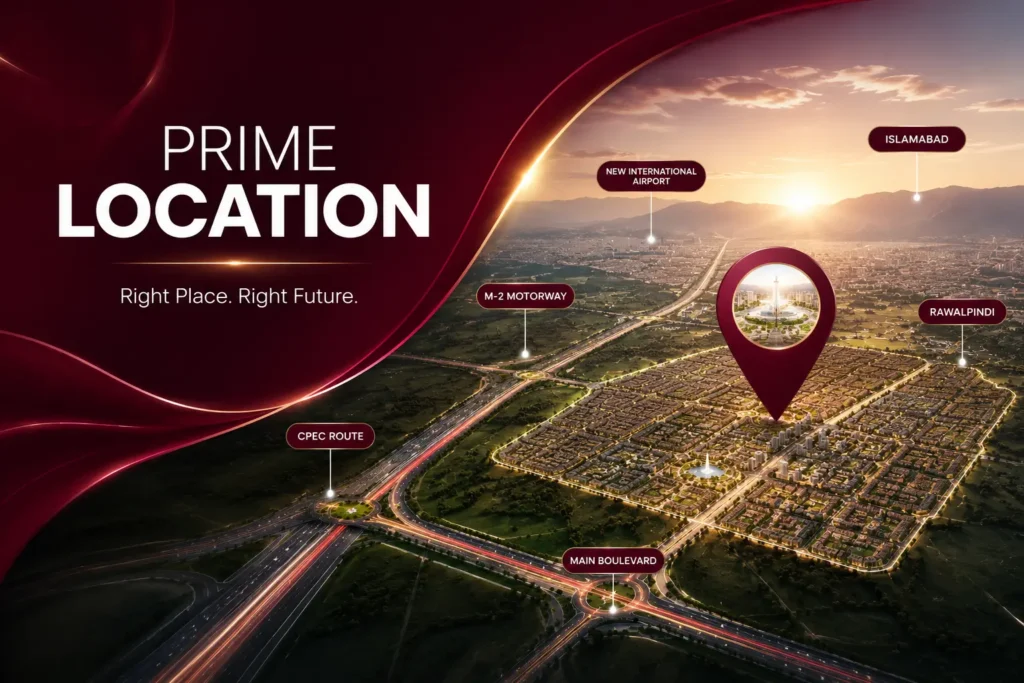
Faisal Town Phase 2 sits near Thalian Interchange on the M-2 Motorway, offering residential and commercial plots with installment plans built around overseas buyers specifically, including a dedicated Overseas Enclave. Being close to New Islamabad International Airport and the wider motorway network gives it a genuine location case, though as of the most recent available reports, its NOC remains in process with the RDA rather than confirmed as approved.
Here’s the current General Block pricing for reference:
| Plot Size | Total Price | Down Payment | Lump-Sum Price (20% off) |
| 5.56 Marla | Rs 27,95,000 | Rs 5,95,000 | Rs 22,40,000 |
| 8 Marla | Rs 38,25,000 | Rs 7,25,000 | Rs 30,60,000 |
| 10.89 Marla | Rs 49,25,000 | Rs 8,45,000 | Rs 39,40,000 |
| 1 Kanal | Rs 80,55,000 | Rs 12,65,000 | Rs 64,40,000 |
Full installment breakdowns, plus separate Overseas Enclave pricing, are available on the developer’s official payment plan page. Confirm current figures with an authorized dealer before booking.
Faisal Hills sits further along the Islamabad-Peshawar corridor, on hillier, more scenic terrain compared to Faisal Town Phase 2’s flatter layout. Before booking into either, confirm current NOC status directly with the relevant authority, ask for updated layout plans since sector boundaries have shifted before, and compare pricing across more than one block rather than taking the first quote you’re given.
Neither project is the only reasonable option in Islamabad’s property market. They’re simply two of the more talked-about ones among UK-based buyers, largely on pricing and location. Word-of-mouth from relatives carries real weight, but it should never replace your own documentation check.
Telling an Approved Housing Society From an Unapproved One
This is one of the more important distinctions in Pakistani real estate, and it’s worth understanding clearly.
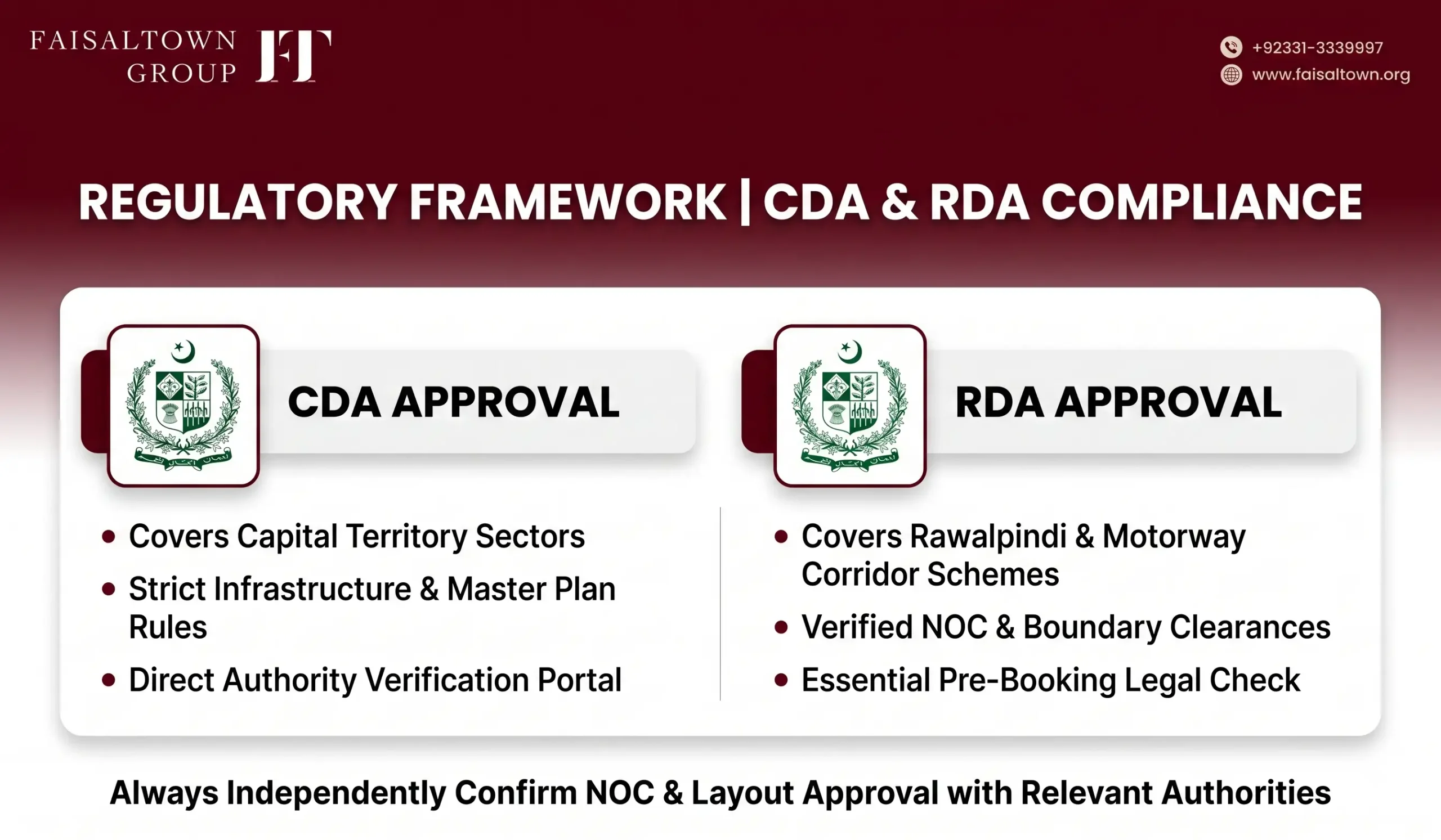
CDA-approved societies fall under the Capital Development Authority’s jurisdiction within Islamabad itself. Approval means the scheme has met infrastructure, zoning, and legal requirements.
RDA-approved societies fall under the Rawalpindi Development Authority, covering schemes in and around Rawalpindi, including several along the Chakri Road corridor near Thalian Interchange.
Check the CDA or RDA’s own portal directly, or contact their offices, before transferring any money toward a booking. This single habit prevents the majority of fraud cases involving overseas Pakistanis.
The Due Diligence Checklist No Overseas Buyer Should Skip
Verification matters more than almost anything else in this whole process, especially when you can’t be physically present.
- Fard-e-Malkiat (ownership record): obtained from the relevant land revenue office to confirm the seller’s legal ownership
- Non-encumbrance certificate: confirms the property carries no outstanding loans, disputes, or legal claims
- NOC verification: for any housing society, confirmed directly with CDA, RDA, or the relevant authority
- Physical site verification: a trusted family member, lawyer, or paid verification service confirming the site matches its documentation
- Developer track record: researched independently, not taken from the developer’s own marketing
Never skip this because a relative or friend is involved. Property disputes in Pakistan very often trace back to informal transactions where paperwork got treated as a formality instead of a requirement.
Buying From Abroad: The Full Transaction Process
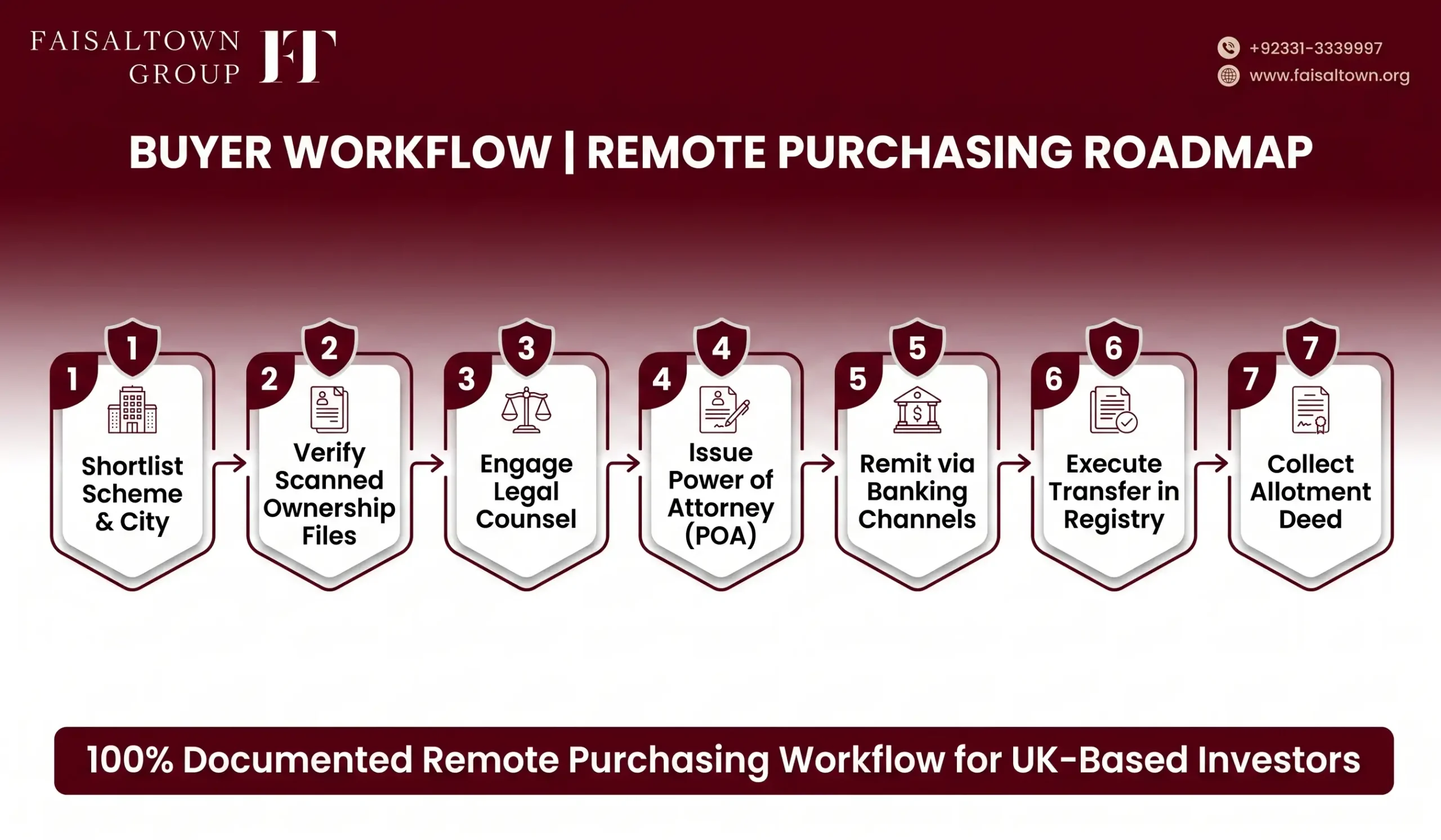
- Research and shortlist cities and schemes that fit your budget and goals, comparing options like Faisal Town Phase 2, DHA sectors, or Bahria Town phases against each other.
- Verify documentation remotely, requesting scanned ownership documents, NOC letters, and approval certificates.
- Engage a lawyer in Pakistan who can run due diligence on your behalf and represent you through the transaction.
- Issue a Power of Attorney, properly attested, so a trusted representative can sign documents when you can’t be there.
- Pay through documented banking channels, never informal or hawala-style transfers, to keep a legal trail of where the money came from.
- Complete the transfer, either through registration at the Sub-Registrar’s Office or the housing society’s own transfer department.
- Keep certified copies of the transfer deed, allotment letter, or possession letter somewhere safe.
Understanding this sequence in advance saves real time once you’ve actually committed to a purchase.
Roshan Digital Account and Other Ways to Fund Your Investment
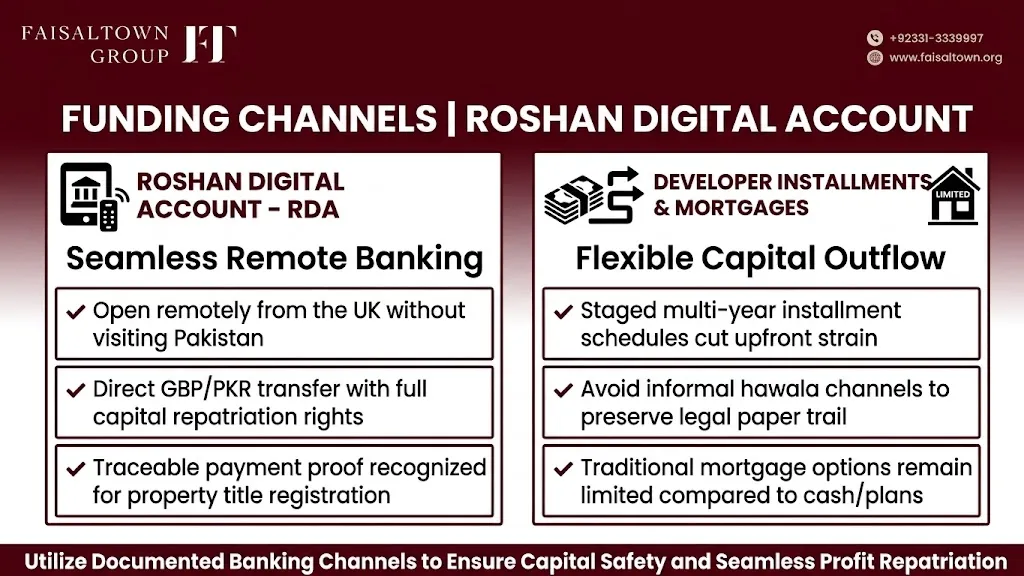
The Roshan Digital Account changed how overseas Pakistanis approach this. Through one, UK-based investors can open a Pakistani bank account remotely, transfer funds directly in GBP at competitive rates, invest in Naya Pakistan Certificates and approved real estate instruments, and repatriate profits back to the UK under standard regulations.
Beyond that, most developers offer their own installment-based payment plans, letting buyers spread cost across months or years rather than paying a lump sum. Faisal Town Phase 2 is one example of a scheme built with exactly this kind of flexible structure in mind for overseas budgets.
Traditional mortgage financing is still limited in Pakistan compared to the UK system, so most overseas buyers rely on savings, remittances, or developer installment plans rather than a bank mortgage.
What Tax You’ll Actually Owe
A few taxes come up repeatedly for overseas buyers:
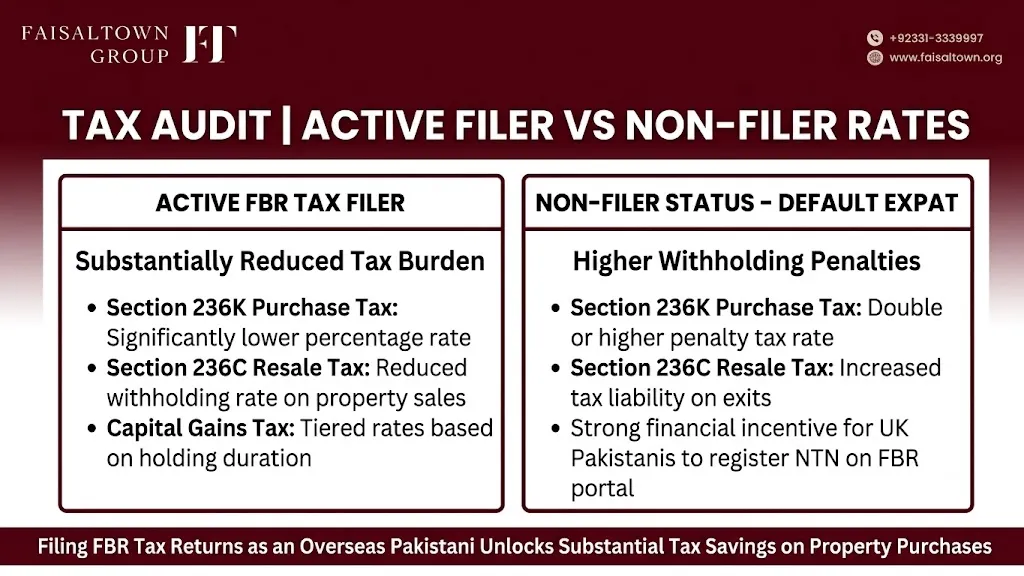
- Advance tax on purchase (Section 236K): paid by the buyer at registration
- Advance tax on sale (Section 236C): paid by the seller, relevant to know if you plan to resell later
- Capital Gains Tax: applies to profit on resale, with the rate depending on how long you held the property
- Provincial stamp duty and registration fees: vary by province and city
Filers on the FBR’s Active Taxpayers List generally pay lower rates than non-filers, which is a strong argument for overseas Pakistanis to file returns in Pakistan even while living abroad, particularly once you hold meaningful property assets there.
Rental Yields vs Capital Growth: Setting Realistic Expectations
These are two different things, and conflating them leads to disappointment.
Rental income in Pakistan tends to run modest as a percentage yield, often somewhere in the low single digits annually, since purchase prices have generally climbed faster than rents in most urban centres. This is especially true for undeveloped plots in newer schemes, which won’t generate any rental income until construction and possession are actually complete.
Capital appreciation has historically been the bigger driver of returns, particularly for buyers who get into a scheme early, before infrastructure is finished. Many investors specifically target early-stage housing schemes for this reason, accepting more uncertainty in exchange for a lower entry price and more room to grow.
A reasonably balanced approach for UK-based investors often means combining one or two early-stage plots, where appreciation potential runs higher, with at least one property in an already-developed area that can generate steadier rental income sooner.
Mistakes That Cost UK-Based Buyers the Most
- Skipping physical verification, relying only on photos or verbal assurance from a seller
- Paying everything upfront, missing out on the protection a staged payment plan offers
- Ignoring NOC status, booking into a scheme before its approval is actually finalised
- Skipping a lawyer to save on fees, then facing a far costlier dispute later
- Overlooking resale demand, buying purely on family pressure without checking whether the plot would actually be easy to sell later
- Using informal transfer channels, which creates real problems establishing a legal trail for the funds afterward
A Practical Checklist Before You Commit
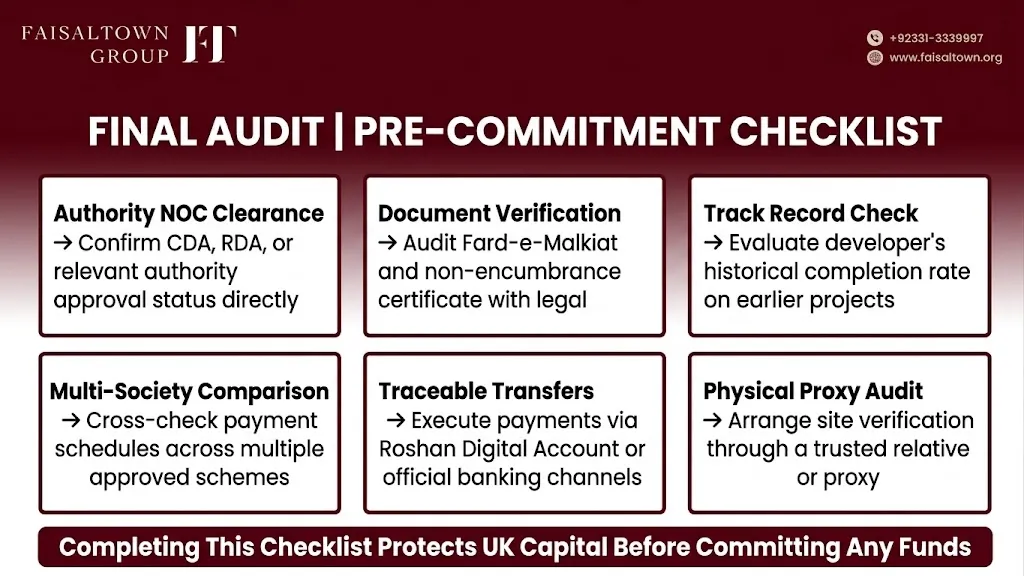
- Confirm CDA, RDA, or the relevant authority’s approval status directly
- Verify ownership documents and the non-encumbrance certificate
- Check the developer’s actual delivery record on past projects
- Compare payment plans across more than one society or block
- Engage a licensed property lawyer in Pakistan
- Use a Roshan Digital Account or another documented banking channel
- Arrange physical site verification through someone you trust
- Understand the applicable taxes before you commit any funds
- Keep certified copies of every transfer and registration document
- Reach out to the Overseas Pakistanis Foundation (OPF) for guidance where it’s relevant
Pakistan’s Property Market Outlook for 2026
Analysts generally expect steady, if unspectacular, growth across the twin-city markets, driven by continued infrastructure spending, motorway expansion, and remittance-backed demand that shows little sign of slowing. Emerging societies near motorway interchanges, including areas around Thalian Interchange, are broadly expected to see stronger appreciation than already-saturated inner-city sectors, simply because there’s more room left for infrastructure-driven growth.
That said, treat any forecast as directional rather than guaranteed. Pakistan’s property market remains sensitive to currency swings, interest rates, and political conditions, none of which move in a straight line.
Talk to a Verified Consultant Before You Invest
Every option named here, Faisal Town Phase 2 included, carries both genuine opportunity and real risk. What separates a good outcome from an expensive mistake almost always comes down to how carefully you verified before committing, not how good the pitch sounded.
Get in touch with a verified real estate consultant to review current NOC status, payment plans, and legal documentation, whatever city or scheme you’re actually considering, before you commit a single pound.