

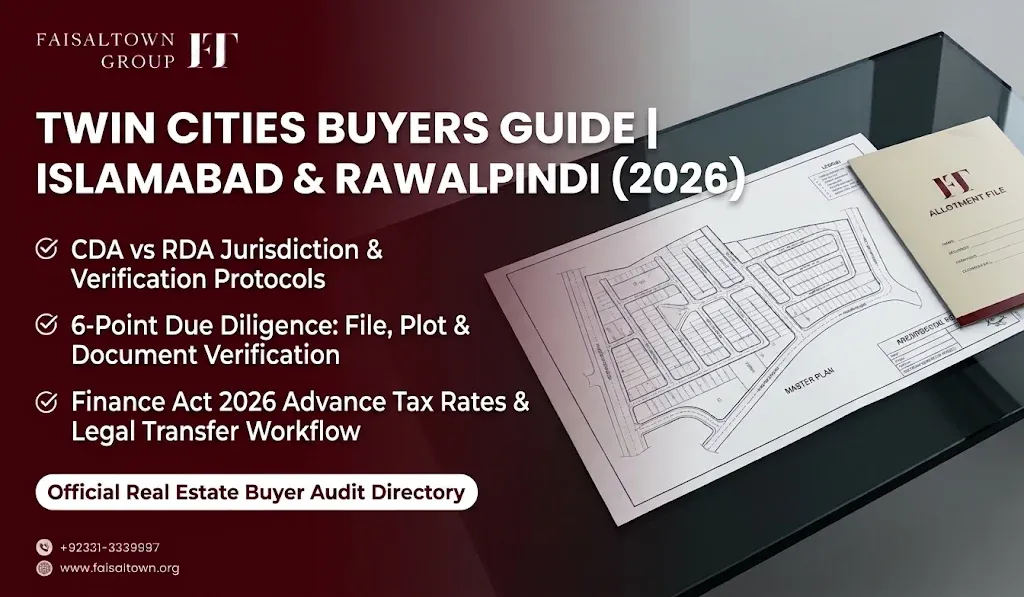
Most people who lose money on a plot in the twin cities don’t lose it on the price. They lose it on things they didn’t check: a scheme that was never approved, a seller whose name doesn’t match the file, or a tax bill nobody mentioned until the transfer day. By then the token is paid and getting it back is hard.
This guide walks you through how to buy property in Islamabad and Rawalpindi in the order the checks should happen. It covers files, balloted plots, houses and apartments, the documents to ask for, the authorities involved, the taxes that apply from 1 July 2026, and what to do differently if you’re buying from abroad. Keep it open while you deal, and tick each step off as you go.
Buying Property at a Glance
Before you pay anything, make sure you have:
- Confirmed whether the land is under CDA or RDA
- Found the scheme on that authority’s official list
- Visited the plot and matched it with the papers
- Matched the seller’s CNIC with every document
- Worked out the taxes and transfer charges
- Paid the token only through a bank
If all six are done, you’re buying on facts rather than promises.
1. Know What You’re Buying
A file, a balloted plot and a built house carry different risks, so start by being clear about which one is on the table.
- A file is a right to a plot that has no number or location yet. You can’t visit it, so the scheme’s approval and the developer’s record matter most.
- A balloted plot has a number, block and size. You can stand on it, measure it and see what’s around it.
- A house or apartment adds building quality, approved plans and utility connections to your checklist.
Each type also changes how fast you can get your money back if you need to sell. A balloted plot in a developed block is usually easier to resell than an open file, because the next buyer can see exactly what they’re getting. A house is easier to live in straight away, but it brings its own checks on construction and approvals.
Think about your goal before you look at listings. If you want to build within a year or two, an open file won’t help you much, however cheap it looks. If you’re buying to hold for the long term, you may accept a plot in a block that’s still being developed, as long as the approval picture is clear.
If you’re still deciding where to buy, compare a few areas on travel time, facilities and approval status before you shortlist any property. Pick the area first, then the property.
2. Check the Authority and the Approval
CDA or RDA?
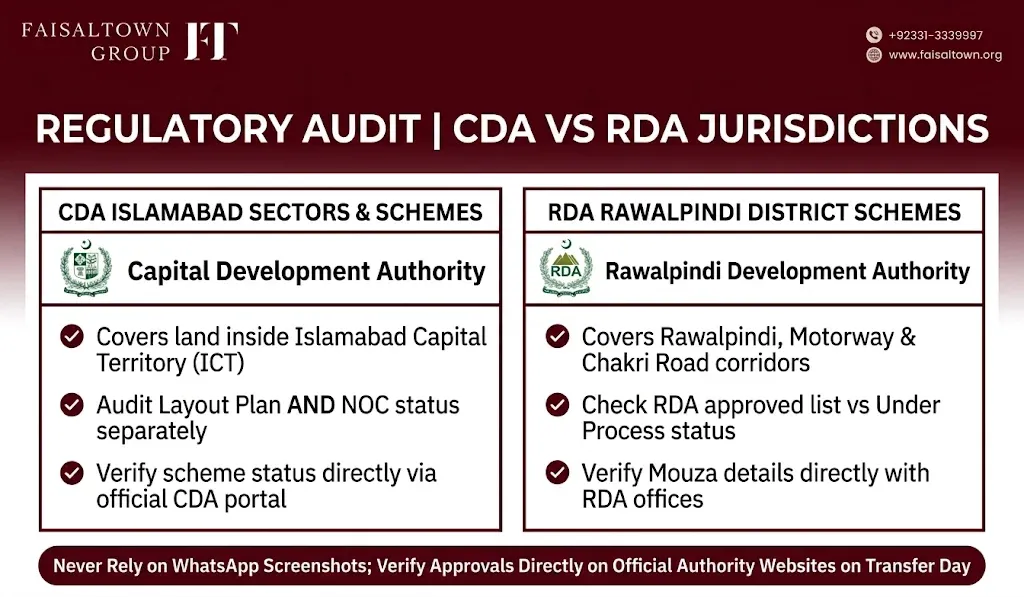
Land inside Islamabad Capital Territory falls under the Capital Development Authority. Land in Rawalpindi district falls under the Rawalpindi Development Authority. The two keep separate lists, so the first job is to find out which one applies. Ask for the mouza (revenue area) from the documents and confirm it.
This matters more than many buyers expect. A scheme can carry “Islamabad” in its name and still sit in Rawalpindi district, and the reverse can also happen. The name on the billboard doesn’t decide which authority’s rules apply. The location does.
Reading the Official Lists
On CDA’s private housing schemes register, each scheme shows two separate lines: the layout plan and the NOC. A scheme can have an approved layout plan while its NOC still says “Not Issued”, so read both. On the RDA lists, the status wording also varies, from final NOC to layout plan approval only.
Words like “file submitted” or “under process” don’t mean approval. CDA has sealed offices and withdrawn layout plans of several schemes in 2026, so search the exact scheme name and location, not just a similar name. For a worked example of how one project’s approval status is explained, see the page on Faisal Town Phase 2 NOC status, and then compare it with what the authority’s own list shows.
Don’t Rely on Screenshots
Dealers often share a screenshot of an approval list on WhatsApp. Treat it only as a starting point. Open the authority’s own page yourself on the day you plan to pay, and search the name there. A screenshot can be old, cropped or edited, and approvals can change after it was taken.
3. Visit the Plot Before You Sign
A plot that looks perfect on a map can look very different on the ground. One visit, done properly, can save you from most surprises.
When you go, take the plot documents, a measuring tape and your phone for photos. Then check:
- The plot number and block match what’s written in your papers
- Corner pillars or boundary marks are in place
- The size on the ground matches the size on the file
- Road access is real, not just drawn on the plan
- Electricity poles, water lines and drains reach the area
- Nearby plots aren’t encroaching on yours
It helps to visit on a weekday as well as a weekend. Traffic, noise and how busy the area feels can change a lot from day to day. If neighbours are around, ask them how long they’ve lived there and what they’ve noticed about development in the block. People living nearby often know more than any brochure.
Finally, ask the society office to confirm the plot’s location and size from its own records. Write down the name of the person you spoke to and the date.
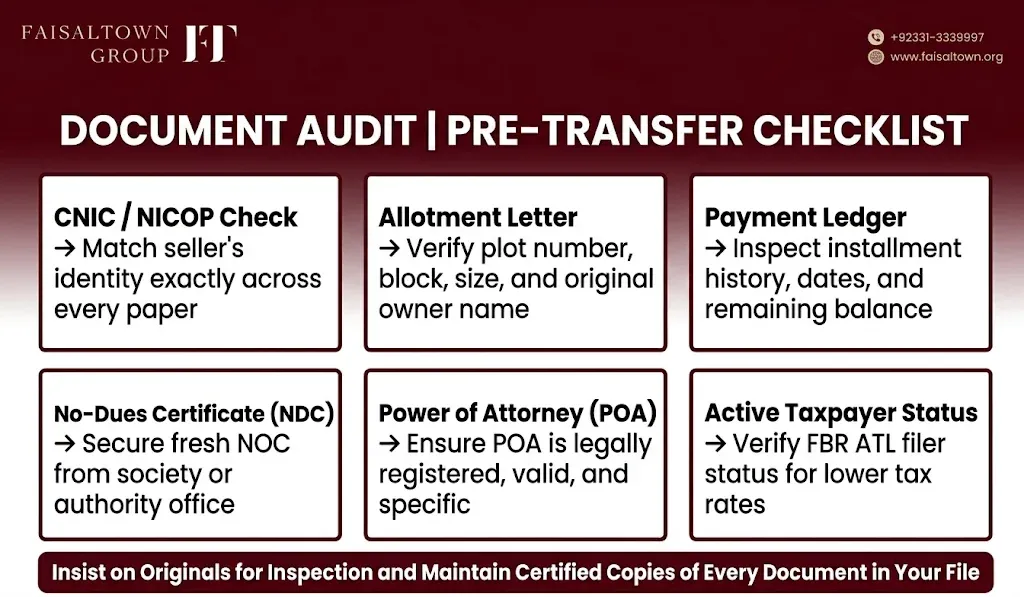
4. Documents Required to Buy Property
Ask for originals, not photocopies, and match every name and number yourself. This table shows what to check:
| Document | What to Check |
| Seller’s CNIC or NICOP | Name and number match every other paper |
| Allotment letter or title document | Plot number, block, size and owner’s name |
| Payment ledger and receipts | Amount paid, dues left, dates |
| No-dues certificate | Recent and issued by the society or authority |
| Possession letter (if any) | Plot number and date match the file |
| Power of attorney (if used) | Registered, valid and clearly covering the sale |
As the buyer, you’ll need your own CNIC or NICOP, photographs and your filer status from FBR’s Active Taxpayers’ List. If someone is selling on another person’s behalf, treat the power of attorney as the most important paper in the file. A vague or unregistered one is a good reason to walk away.
Pay attention to the payment ledger as well. It shows whether installments were paid on time and whether anything is still due. If a seller has missed installments, the society may charge a late fee or, in some cases, take action on the file. Make sure the seller clears every due before the transfer, not after.
Keep a copy of everything you’re shown, even documents you don’t end up needing. If a dispute comes up later, a clear paper trail is your best protection.
5. Property Taxes and Transfer Charges in 2026
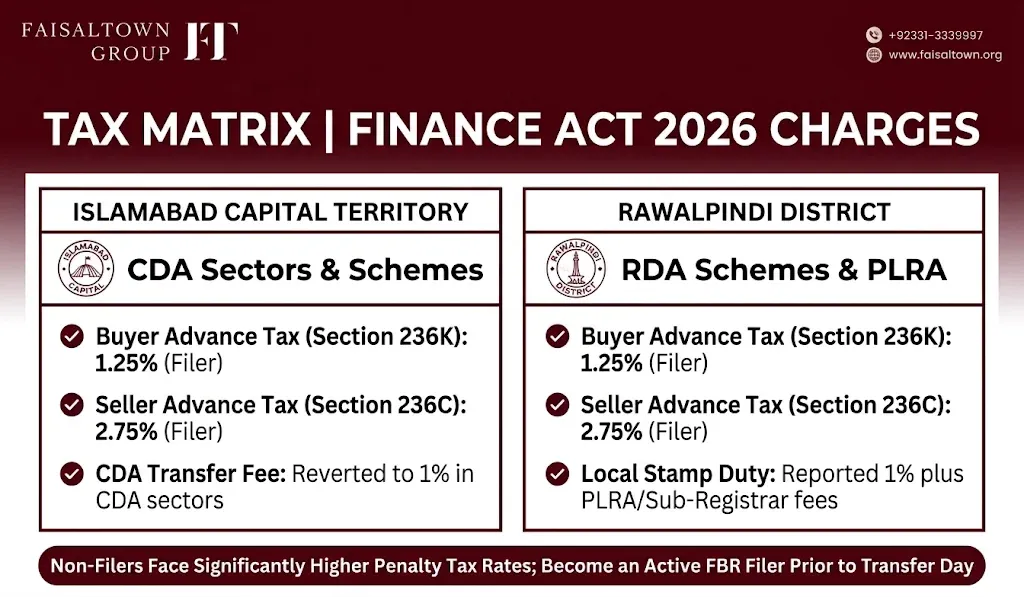
From 1 July 2026, under the Finance Act 2026, filers pay a flat 1.25% advance tax when buying (Section 236K) and 2.75% when selling (Section 236C). Non-filers pay much higher rates. In some projects 236K can also apply to installments, as the note on Section 236K tax on installments explains.
Here’s how the main costs compare in the two cities:
| Cost | Islamabad | Rawalpindi |
| Buyer’s tax (filer) | 1.25% | 1.25% |
| Seller’s tax (filer) | 2.75% | 2.75% |
| Local charge | CDA transfer fee in its sectors | Stamp duty, reported at 1% |
| Other fees | Set by the authority | Registrar and PLRA fees |
The News reported in April 2026 that CDA had decided to bring its transfer fee in its sectors back to 1% after raising it to 3% in July 2025. In Rawalpindi, The Express Tribune reported a 1% stamp duty plus registration and comparison fees when registrations resumed in July 2026.
To give a rough idea, on a Rs10 million purchase a filer would pay Rs125,000 in advance tax, and a 1% local charge would add about Rs100,000 more before other fees. Treat that as an example only and ask for the final figure on your challan.
Becoming a Filer First
The gap between filer and non-filer rates is large enough that it’s usually worth sorting out your tax status before you buy. Check whether your name appears on the Active Taxpayers’ List on the FBR website. If it doesn’t, speak to a tax adviser about filing your return before the transfer date, so the lower rate applies.
Who Pays What
Agree in writing who pays each charge. By law the buyer pays 236K and the seller pays 236C, but society transfer fees and other charges are often split by agreement. Leaving this vague is one of the most common reasons deals fall apart on transfer day.
6. The Buying Process Step by Step
The forms differ between societies and authorities, but the order is broadly the same:
- Agree the terms in writing. Price, plot or file number, payment schedule and who pays which charge.
- Pay the token through a bank. The receipt should show the plot or file number and both names.
- Clear the dues. The seller settles any pending installments and gets a no-dues certificate.
- Pay the taxes. Buyer and seller each deposit their tax through FBR challans.
- Submit the transfer. Inside a society, at its transfer office. For registered property, at the registrar.
- Complete biometric verification. Both parties usually need to be present.
- Collect the new papers. A transfer letter or registered deed in your name.
No official processing time is published for either city, so ask the society or registrar how long it’s currently taking. In Rawalpindi, registrar offices began requiring a physical inspection of each property before registration in August 2026, which slowed some deals.
A token agreement should also say what happens if either side backs out. Common terms set out whether the token is returned, forfeited or doubled, and by what date the full payment must be made. If you’re not sure about the wording, have a lawyer read it before you sign. A small legal fee is cheap compared with a disputed token. If you’re buying on installments from a developer rather than resale, read the Faisal Town Phase 2 payment plan to see how a booking amount, installments and dues are usually set out, and match them with your agreement.
7. Buying From Abroad
Many overseas Pakistanis buy plots in the twin cities, and they face extra risk because they can’t easily visit or attend the transfer.
The usual route is a registered power of attorney given to a relative or person you trust completely. Make sure it’s prepared properly, registered and limited to the deal you have in mind. A very broad power of attorney gives the holder more control over your property than you may want.
A few habits make remote buying much safer:
- Never send money to a personal account
- Ask for video of the plot and the society office visit
- Get scanned copies of every document before paying
- Check the scheme on CDA’s or RDA’s site yourself
- Keep all agreements and receipts in one folder
If something feels rushed, slow down. A genuine seller will usually wait a few days while you check.
8. Red Flags That Should Stop You
Most problems show up early if you know where to look. Pause the payment if:
- The seller only has photocopies of the file or allotment letter
- The name on the CNIC doesn’t match the file
- A dealer wants the token in cash or in a personal account
- The price is far below similar plots in the same block
- The scheme’s status is “under process” or “file submitted”
- Possession or development dates are promised only verbally
Pressure is a red flag on its own. Lines like “another buyer is coming tomorrow” or “the price goes up next week” are often used to stop you checking. A good deal will usually still be there after a day or two of proper checks.
To get a feel for fair asking prices, compare several similar plots in the same block before you negotiate.
Have Questions About Buying Property in Islamabad or Rawalpindi? Talk to Our Team Today
Buying property in the twin cities goes smoothly when the checks come before the money: confirm the authority, read the approval on the official list, visit the plot, match every document and work out the taxes in advance. Before your next visit, note the scheme name, plot number and seller’s name, and confirm your filer status on FBR’s Active Taxpayers’ List. If you’d like help going through the documents or the charges on a specific plot, call or WhatsApp our team at +92 331 3339997, or email info@faisaltown.org, and we’ll walk you through it with no pressure to decide before you’re ready.
FAQs
Is a layout plan approval enough to buy in a housing scheme?
No. On CDA’s register the layout plan and the NOC are separate lines. Check both, and treat a missing NOC as a risk.
How do I know if a scheme is under CDA or RDA?
Get the exact location and mouza from the documents, then check whether the scheme appears on CDA’s register or RDA’s lists.
What tax does a buyer pay in 2026?
A filer pays 1.25% advance tax under Section 236K from 1 July 2026. Transfer fees, stamp duty and registration charges are extra.
Can I buy property in Islamabad without coming to Pakistan?
Yes, through a properly registered power of attorney given to someone you trust, because biometric verification is usually needed at transfer.
Should I ever pay a token in cash?
It’s safer not to. A bank payment with the plot or file number on the receipt gives you a clear record if anything goes wrong.
Is a file safer or riskier than a balloted plot?
A file usually carries more risk, because there’s no plot to inspect yet. Its value depends heavily on the scheme’s approval and the developer’s record.